Karimpuzha Wild Life Sanctuary
Karimpuzha WLS is the 18th Wildlife Sanctuary (WLS) and 24th Protected Area (PA) of the State and the first WLS in Malappuram District. The name ‘Karimpuzha’ is derived from the Karimpuzha river, a tributary of the river Chaliyar. Karimpuzha WLS is situated nearly 20 km away from Nilambur town. Transportation is available up to Nedumkayam from Karulai. The nearest railway station (Nilambur Road) is 16 km away from the Karimpuzha WLS. The nearest airport, Calicut International Airport at Kondotty, Malappuram, is nearly 60 km away from Karimpuzha WLS.
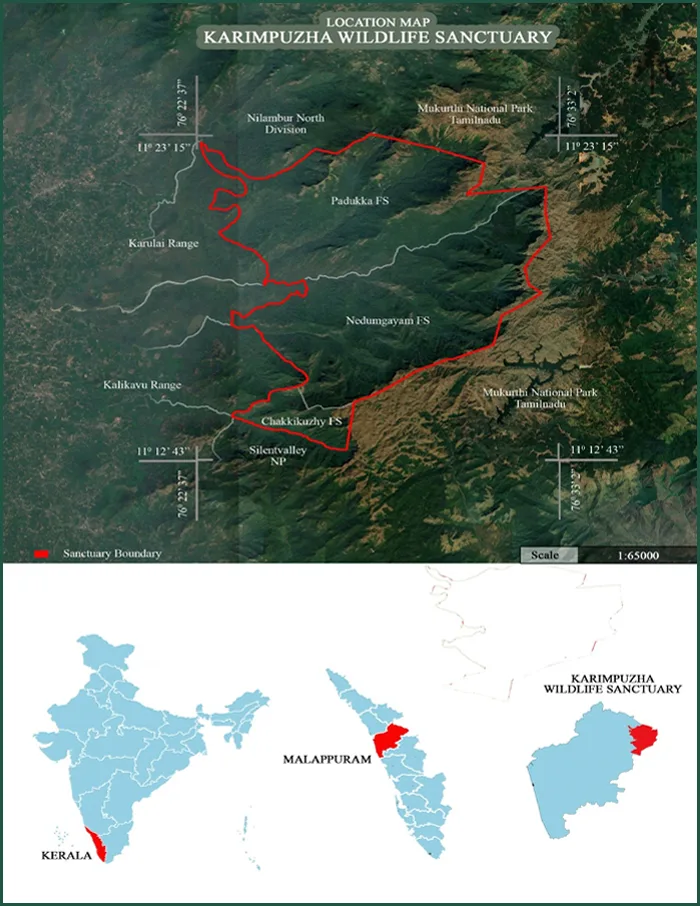
Karimpuzha WLS is located on the western slopes of Nilgiris, lies between the geographical limits of N 11o23’15’’to 11o12’43’’ latitudes and E 76o22’37’’ to 76o33’2’’ longitudes and falls in the Nilambur Taluk of Malappuram Revenue District in Kerala. Karimpuzha WLS area forms part of the revenue villages of Karulai, Moothedam and Amarambalam. The sharp topographical gradient of the hills ranging from 40m to 2550m is the primary reason for the unique biodiversity of the Karimpuzha WLS.
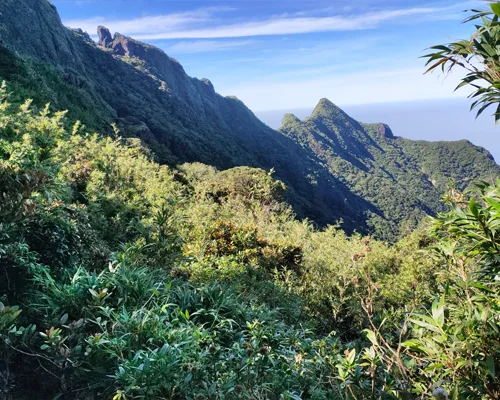
The area merges with landscapes of Tamil Nadu and Kerala. Steep hills, deep valleys, marshy lands, grasslands and shola forests with hillocks, perennial water sources combined with altitudinal variations make it an ideal habitat for a variety of flora and fauna. The area also supports several endemic and many endangered species.
The forest areas of Karimpuzha WLS forms part of the Nilgiri Biosphere Reserve (NBR), recognized under the Man and Biosphere Programme of UNESCO. It is the first and foremost Biosphere Reserve in the country with a rich heritage of flora and fauna.
Karimpuzha WLS along with Silent Valley NP and Attappady RF in Kerala and Mukurthi NP in Tamil Nadu forms part of the Nilgiri Sub-cluster of serially nominated Western Ghats (WG) World Heritage Sites. It also has an exceptionally high level of biological diversity and endemism and is recognized as one of the world’s eight ‘hottest hotspots’ of biological diversity. The forests of the site include some of the best representatives of non-equatorial tropical evergreen forests anywhere and are home to at least 325 globally threatened flora, fauna, bird, amphibian, reptile and fish species.
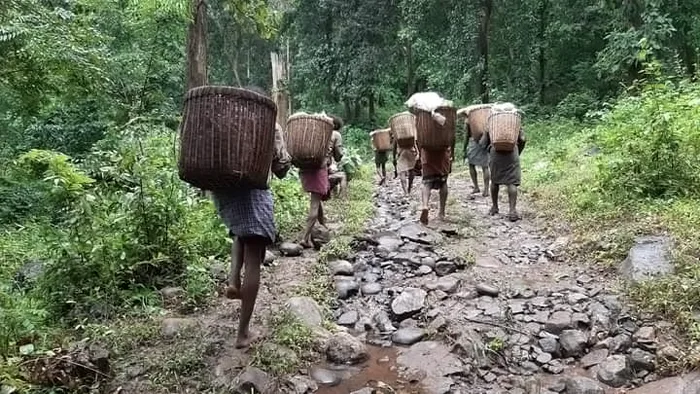
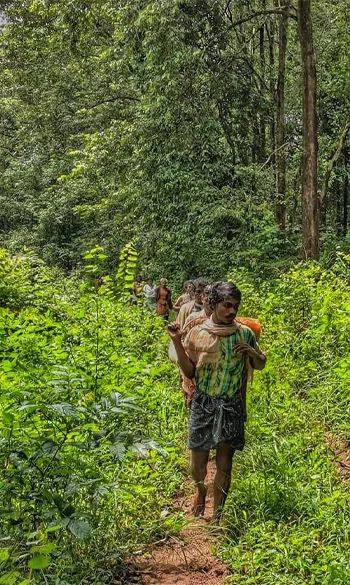
The nomadic tribes, Cholanaikans, Cave men of Kerala, are living inside area of Karimpuzha WLS. They form a small group of tribes with a total population of 217 individuals in 56 families. Majority of them lives in caves and make shift structures. The Cholanaikkan tribe is classified as Particularly Vulnerable Tribal Group by Government of India. They call themselves as Malanaikan or Sholanaikan. Shola or chola means deep thicket in the forest and Naikan means king. The community mainly depends on the forests for their livelihood. They have meager wealth and no weapons. They come out of the forests on every Wednesday to sell the Non-wood Forest Produce (NWFP), which is collected by the Government agency, the Mancheeri Vana Samrakhana Samithy (VSS). They speak a language which is a distinct Dravidian dialect, but it is not directly related to any of the modern Dravidian languages – the sound of their talking gives a whiff of similarity to Malayalam, Tamil and Telugu, but direct association of words is not seen.
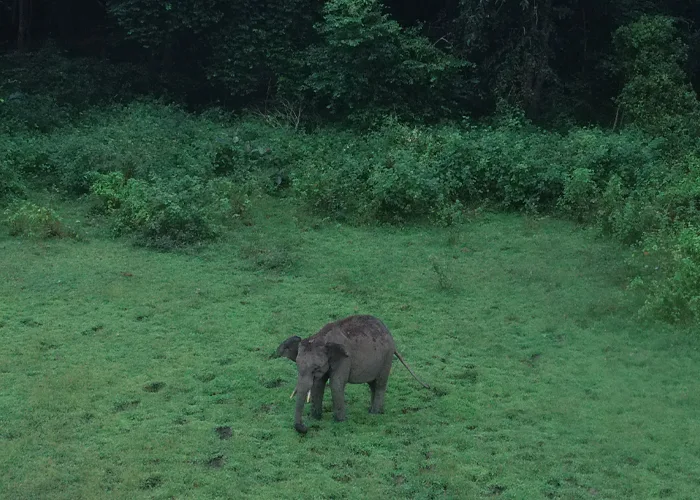
The forest areas of the Karimpuzha WLS forms part of the Nilambur Elephant Reserve (Nilambur ER), one of the four ERs notified in the country. This forest continuum, as part of Nilambur ER, also harbours one of the viable populations of Asian elephants in the world. The latest estimation of elephants in Kerala shows an elephant density of 0.41/km2 (Line transect dung count; 2017) in the Reserve with an estimated population of 710 (ranging from 574 to 877).
The Karimpuzha WLS is the abode of a number of threatened mammals, birds, reptiles, fishes, amphibians and insects. There are 45 species of mammals, 216 species of birds, 48 species of reptiles, 37 species of amphibians and 75 species of fishes recorded from Karimpuzha WLS. Among invertebrates, 860 species of insects are reported. Endemic fauna includes 7 species of mammals, 27 species of birds, 28 species of amphibians, 13 species of reptiles and 20 species of fishes. Tree species belonging to 305 taxa, under 212 genera belonging to 73 families were recorded from this sanctuary. Among the 133 species of butterflies recorded from Karimpuzha WLS, 28 species were found to be of high conservation status being either endemic/protected species. Moreover, Karimpuzha River and its tributaries are home to a good population of Malabar Mahseer (Tor malabaricus), one of the endangered fishes in the world. Slender Loris, Nilgiri Tahr, Tiger, Lion tailed macaque, Gaur, etc. are also sighted here.
The forests harbour diverse floristic and faunal components of Western Ghats in general and the Nilgiri Biosphere Reserve (NBR) in particular. Karimpuzha WLS shares boundary with Mukurthi NP (Tamil Nadu) in eastern side and Silent Valley NP (Kerala) on southern side. Hence, it acts as a continuous PA network, ensuring free movement of wildlife, improving the connectivity and enhances the gene pool of various species.
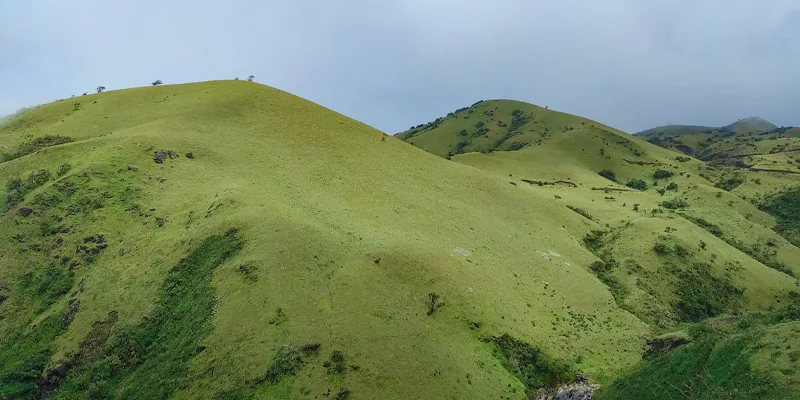
The territory is characteristically unique by virtue of its geographic and biogeographicic antiquity and evolution. The geographic tract extends from low land to high altitude grassland and the sanctuary is the state’s only forest stretch where seven forest types found in the state are all present, including evergreen rainforest, semi-evergreen forest, moist deciduous forest, sub-tropical hill forest, sub-tropical savannah, montane wet temperate forest and montane wet grasslands. Because of this amazing diversity, the sanctuary is home to almost all kinds of animals in the state. While the Eravikulam National Park is famous for the Nilgiri tahr and Silent Valley National Park for the lion-tailed macaque, both the species are found in abundance in the Karimpuzha wildlife sanctuary
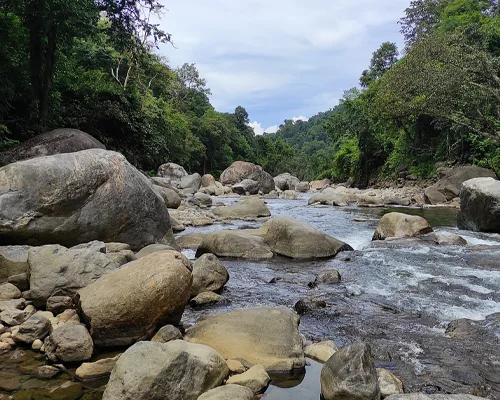
The forest of Karimpuzha WLS constitutes the watershed of river Chaliyar, a major river basin and fourth largest watershed system in Kerala. The Chaliyar river originates at Ilambalari in Tamil Nadu, at an elevation of 2066 meters and drains into arabian sea at Beypore in Kozhikkode. The Vast systems of rivers and streams comprising many sub watersheds and micro watersheds of the sanctuary drain out to river chaliyar. The forests are enriched with several streams which carry water almost throughout the year. The main streams are Karimpuzha, Cherupuzha, Thalippuzha, Chinnathalippuzha, Panappuzha, Manjakallanpuzha, Unakkappuzha, Manalippuzha, Nanchanpuzha etc. These small rivers and rivulets draining the sanctuary plays a crucial role in water sustainability of the region and forms the lifeline of the inhabitants of Malappuram and Kozhikkode Districts in Kerala.
Being a predominantly tribal dominated area, sanctuary’s conservation activities can play a vital role in generating employment and tackling poverty related problems of local population. One of the other major economic values includes Non Wood Forest Produce (NWFP). The collections of NWFP play the vital role in meeting livelihood needs of tribes of the locality. About 119 species of NTFPs are found in the region, which is being collected by various tribal groups and marketed through FDA
Historical Value
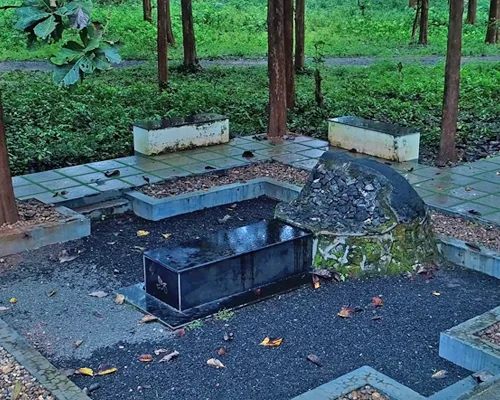
While computing historical value, the role played by the forests in history of the locality and benefits derived are to be taken in to consideration. The New Amarambalam forest was purchased from the private ownership of Edavanna Kovilagam in a public auction and was taken into possession of the Government in 1888. Exploitation of timber started from the area during 1930-31, when an abandoned cart track from Kanhirakadavu at the foothill was reopened and a serambi was built at Meenmutti during 1931-32. There were no bridges along the river Karimpuzha, and later, to facilitate timber transport, a bridge was built at Nedumgayam by Mr. E.S. Dawson, the then Forest Engineer. Later, Mr. E.S. Dawson died in an accident by drowning in the river at Nedumkayam. The tomb of Dawson is also built at his favourite spot in Nedumkayam.
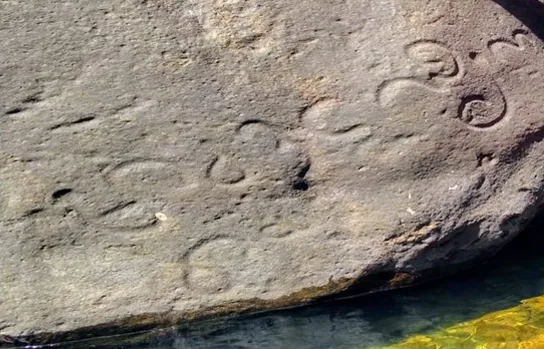
Vattezhuthu on Rock
The historic value of Vattezhuthu inscription on a rock at ‘Ezhuthukkal’ located in the vicinity of the sanctuary, which is believed to be of 5th century AD, one of the reasons that helped in getting Malayalam the status of classic language.
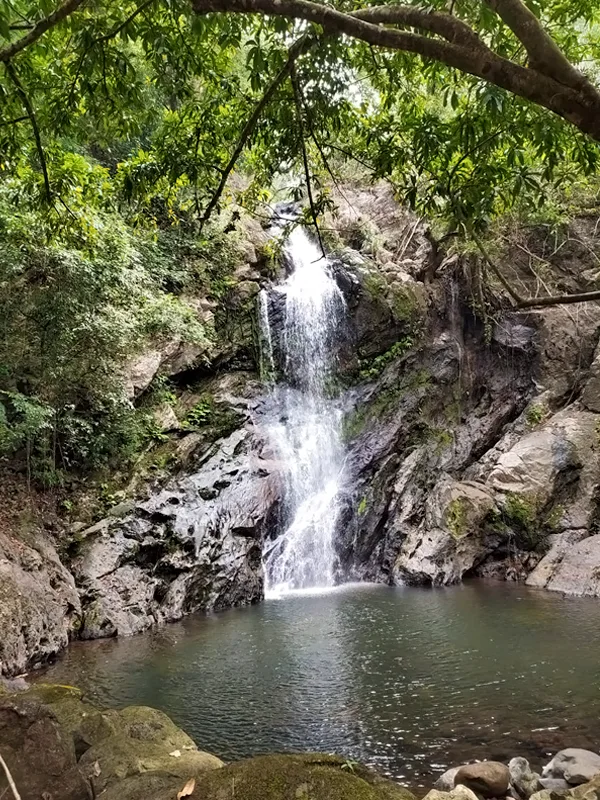
The undulating hills, thick forest, waterfalls and the biodiversity richness add to the scenic beauty of Karimpuzha WLS and provides extensive opportunities for ecotourism, conservation education and interpretation in the district.
The whole area is hilly in character with undulating terrain. The general direction of main ridge runs from north-east to south-west marked by presence of numerous hills and ridges in various directions. The general course of main rivers and streams is westwards. The aspect of Karimpuzha WLS is mainly westerly. This is evident from the natural drainage system. The terrain is rugged in most places with hillocks. Altitude ranges from 40m to 2550m MSL over a horizontal profile of less than 20 km, indicating moderate to steep slopes These hills are not only a warehouse of biodiversity but also provide the much needed “geographical guarding” of the biodiversity of Karimpuzha WLS.
Animals & Habitats
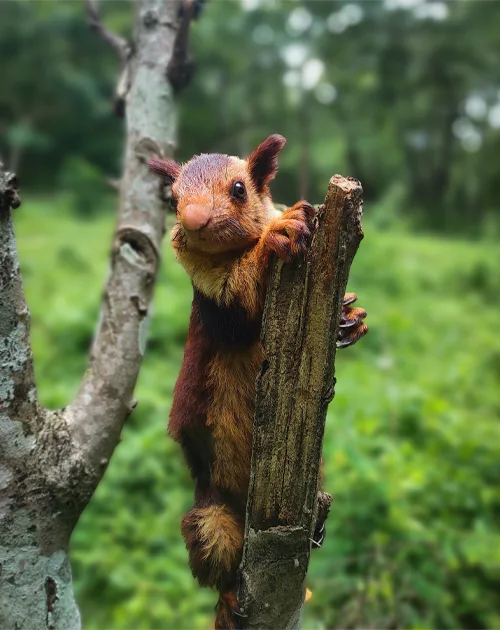
Mammals: - Although several studies have been conducted on mammals in WLSs and NPs in Kerala, there has been very little effort to generate information on their status outside the PAs. Hence there is only limited information available on status of mammals in terms of abundance and distribution in Karimpuzha WLS. 45 species of mammals in 35 genera belonging to 22 families grouped in 9 mammalian orders have been reported from Karimpuzha WLS, of which eight are endemic to Western Ghats (Lion Tailed Macaque, Nilgiri Langur, Black-Footed Grey Langur, Dusky Palm Squirrel, Nilgiri Marten, Nilgiri tahr and Malabar Spiny Dormouse). Black Footed Grey Langur is known only from this part of NBR stretching from the forests of Karnataka to Silent Valley and their population is good in the foothills of Mancheeri and Nedumkayam areas of the New Amarambalam RF. Enhanced availability of reed brakes and grasslands in the upper reaches enables to have a good population of elephants in this sanctuary. Critically endangered species Nilgiri Marten is also reported from Karimpuzha WLS. Nearly half the number of total mammalian species falls in Schedule I and Schedule II of the Wild Life (protection) Act 1972, like Tiger, Leopard, Leopard Cat, Jungle Cat, Pangolin, Slender Loris, Mouse Deer, Wild Dog, Flying Squirrel and Sloth Beer are seen.
Avifauna: - Karimpuzha WLS is abode to more than 226 species, out of which 27 are endemic to WG. All the four species of hornbills reported in Kerala are reported from here also. Some of the birds seen here includes Nilgiri Laughing Thrush, Nilgiri Wood Pigeon, Lesser Adjutant, Spot- Bellied Eagle Owl, Sri Lankan Frog Mouth, Rufus Bellied Eagle, Drongo, Cuckoo, Nilgiri House Swallow, Black Throated Munia, Waynad Laughing Thrush, Blue Rock Thrush, Nilgiri Wood Pigeon, Blue winged Parakeet, Southern Tree Pie, Small Sunbird, Grey Headed Bulbul, Nilgiri Flycatcher.
Herpetofauna: - 48 species of reptiles with 13 endemic species have been reported from here. Of the 48 species of reptiles, snakes dominate with 14 species, followed by 10 species of Lizards and 4 species of turtles and tortoises. Various reptiles include Flying Lizard (Draco dussumeri), Geckos (Cnemaspis wynadensis), Green Calotes (Calotes calotes), Roux’s Forest Lizard (Calotes rouxii), Monitor Lizard (Varanus benghalensis), Cobra (Naja naja), King Cobra (Ophiophagus hannah), Krait (Bungarus caeruleus), Russel’s Viper (Vipera russelli), Large Scaled Pit Viper (Trimeresurus macrolepis), Saw Scaled Viper (Echis carninatus), Malabar Pit Viper (Trimeresurs malabaricus), Indian Rock Python (Python molrulus), Rat snake (Ptyas mucosus), Common Green Whip Snake, Brown Whip Snake, Anamala Green Whip Snake, Common Indian Bronze Back Snake etc
Amphibians: - The amphibian richness of Karimpuzha WLS is very high. Nyctibatrachus minimus, Raorchestes anili, Raorchestes akroparallagi etc. are examples for this. Various aquatic systems rivers, check dams, marshy lands provide favorable habitat for frogs and toads. A total of 37 species of amphibians have been recorded, consisting of 4 species of toads, 27 frogs, and 6 ceacilians. 19 species are endemisc to Western Ghats and 8 species are endemic to Kerala. Some of the important species includes Duttaphrynus microtympanum, Duttaphrynus parietalis, Zakerana nilagirica, Micrixalus Saxicola, Indosylvirana indica, Indirana beddomii, Raorchestes nerostagana, Raorchestes tinniens and Rhacophorus malabaricus
Pisces: - 43 species of freshwater fish belonging to 13 families and 28 genera from various tributaries of Chaliyar River, draining the New Amarambalam RF were recorded. Family Cyprinidae dominated with 20 species followed by Balitoridae and Bagridae. Of the 43 species, 20 species (46.51%) are endemic to the Western Ghats with one species (Laubuca fasciata) strictly endemic to the Kerala region. The fish diversity in New Amarambalam RF is high compared to various protected areas in the Nilgiri landscape such as Wayanad WLS and Silent Valley NP in Kerala and the Mudumalai WLS in Tamil Nadu (Biju, 2005). New Amarambalam RF harbours higher freshwater fish species diversity than in protected areas of northern Kerala (north of Palakkad gap). The streams inside New Amarambalam RF especially the Karimpuzha tributary needs to be designated as a priority area for freshwater fish conservation. Mancheeri located in the Karimpuzha tributary need to be selected for long term protection and monitoring of fish diversity, as it harbours good population of two very important endemic species, Tor malabaricus and Glyptothorax annandalei. The absence of human habitation along the banks of this tributary except for settlements of the Cholanaikkar and Kattunaikkar tribes means that there is no organized and large-scale exploitation of these fishes. However, the fishing techniques used by these tribes are mainly destructive in nature and causes large scale mortality to the entire aquatic fauna present in the vicinity including fish, molluscs, crustaceans and insects. The most common destructive fishing techniques practices by the tribes include poisoning using leaves, barks and fruits of several trees such as Acacia torta, Randia brandisii and Zyzigium caryophyllaeum. There are also reports of fishing using dynamite by non-tribal communities residing along the fringes of the Kaimpuzha WLS. Hence an urgent need to create awareness among local communities including tribes on the importance of the stream habitat and its fish fauna and the need to conserve them for future generations.
Important invertebrates, invertebrates, their status, distribution and habitat: -Karimpuzha WLS is rich in invertebrate populations. The microorganisms like Amoeba, Paramaesium etc are the representatives of protozoas. The hydra present in the river and streams are the Coelenterates. Nature’s plougher, earth worms and leeches are the representatives of Annelida. The terrestrial molluscs are the representatives of the molluscs group. The millipedes, centipedes, various types of bees, butterflies, spiders etc are examples of Arthropods.
The study conducted by KFRI by lying plots at various points in forests has also brought into limelight about the tremendous diversity in insect population in Karimpuzha WLS. Of the 860 species collected from New Amarambalam, 503 species have been identified which included 133 species of butterflies, 202 of moths, 65 of Coleoptera, 51 of Hymenoptera, 35 of Hemiptera, eight of Orthoptera, six of Odonata, two of Dictyoptera, and one of Neuroptera.
Butterflies and moths: - The butterflies belonged to 10 families with Nymphalidae and Lycaenidae containing maximum number of species followed by Danaidae and Satyridae. The families Riodinidae, Libytheidae and Acraeidae contained only one species each. The evergreen forests contained maximum number of butterflies (96 spp.), followed by semi evergreen (84 spp.), moist deciduous (64 spp.), sub-tropical hill forest (30 spp.) and montane shola forest (22 spp.).
The distribution of various endemic/protected species showed specialization in relation to the habitat as shown below in Table 2.3
Dragonflies and Damselflies (Odonata): - Networks of streams and rivers in the New Amarambalam area provides a good habitat for dragonflies and damselflies. Rao & Lahiri (1982) reported 23 species of odonata from the region. About 52 species of Odonata under 11 genera belonging to 11 families are known from the region. The suborder Anisoptera (dragonflies) dominates with 26 species and the suborder Zygoptera (damselflies) represented with 25 species. Of these, twelve are Western Ghats endemic such as Psudagrion malabaricum, Ceriagrion auranticum, Euphae fraseri E. dispar, Phylloneura westermanni, Protosticta hiersevi, Caconeura ramburi, Caconeura risi, Copera vittata, Hylaeothemis fruhstorferi, Zygonyx malabaricus and Idionyx suffronata. Species like Neurobasis chinensis, Rhinocyha bisignata, Vestalils apiclais etc, which are normally found associated with the hill streams and their vicinities, have also been recorded fairly in good numbers.Species inventories on invertebrates like protozoans, annelids, arthropods (except insects) and Molluscans of Karimpuzha WLS is not exhaustive. Hence it is proposed to conduct studies /surveys on various invertebrate species during the plan period.
Villages
VILLAGES INSIDE AND OUTSIDE THE PA.: There are no villages or settlements inside the PA. However, Cholanaikens, the primitive hill tribe inhabits the forests of the sanctuary. They are a small group of tribes with a total population of 217 persons, most of them live in caves and temporary self-built structures inside the sanctuary. Cholanaikan are gatherer‐hunter tribe and have no permanent settlement. Nedumkayam, Uchakkulam and Pattakkarimbu settlements located near the sanctuary are inhabited by Paniya and Kattunaiken tribes. Traditions, customs, and relationship with resources, habitats of these tribes are given below.
Cholanaikens: The Cholanaikans (coolanaaykkan) are called the Cavemen of Kerala. They are classified as Primitive Tribal Group by Government of India and are still in the pre-agricultural level of development. This primitive hill tribe inhabits the forests of the sanctuary. Cholanaikan are gatherer‐hunters and generally said to have no knowledge of agriculture During monsoon they live in temporary shelters alongside rivers and shift to caves in the summer. They reside in semi evergreen and moist deciduous forests. They still live in the rock shelters called aale. Among the Cholanaickan, ‘naadu’ are territorial divisions,
which are also clearly demarcated by rocks, trees, streams and hills. Territory is called ‘chemmam’ and the each ‘chemmam’ has a headman called ‘Chemmakkaran’. An individual is known after the territory, since the name of the territory is prefixed with the name of an individual such as Karimpuzha Kungan, Paanapuzha Kungan, Kuppanmala Kethan, Taalipuzha Kungan, Puuchappara Kungan etc. Similarly, women are also known after their territories, which are exogamous, patrilineal and patrilocal. Tribal Department has built houses for them at Mancheri by the banks of river Karimpuzha. However, all but two houses have been abandoned. They do not prefer to live in these permanent dwellings (except two houses), since they prefer to stay in their original habitations. In order to assist them, the government agencies have a weekly interaction programme every Wednesday. During these meetings, they are given weekly ration which includes rice, wheat, oil, potatoes, spices and onions.During such interactions the Cholanaikkans also sell their items such as honey, baskets etc to Mancheri VSS.
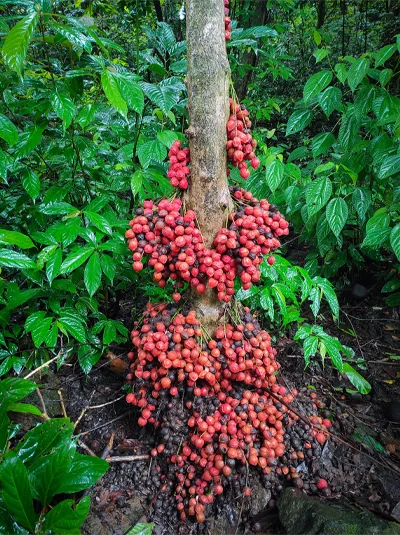
a. Dependency on forests for Food resources: Even though regular supply of rations is given on every Wednesday; they depend on forests of sanctuary for their traditional foods. They primarily eat plants, leaves, fruits, mushrooms, seeds and tubers but diet also include fish, birds, turtles and other smaller animals. They do not use milk at all. Cholanaikkan have very good knowledge about the wild plants in surrounding forests and they knew- what plants are useful to eat and how to avoid harmful plants from edible plants. A total of 102 plant species are used by them for food. Out of these, ninety-nine species belong to angiosperm, two species belong to pteridophytes and one plant belong to gymnosperms. It is also found that 36 species are used as fruits, 21 species yield tubers, 19 species used as leafy vegetable, 10 species, and seeds are used for various purposes, 7 species whole plant is used.
b. NWFP collection by Cholanaikans: These tribes are depending the forest for collection of NWFPs. NWFPs thus play a significant role in augmenting the income of Cholanaikans. The vast majority of NWFPs are consumed directly by the tribes that collect them and their families. The ubiquitous use of bamboo in the construction of buildings and utility items in tribal colonies areas, or the regular consumption of wild vegetables, are examples. They collect honey, black dammar, mosses, pathri, shikakai, etc. from the forest and are collected by Nilambur South FDA through Mancheeri VSS.
c. Ethnobotanical knowledge: The traditional knowledge of Cholanaikens has high ethno botanical importance. In an ethno botanical survey carried out among these tribes, could identify the ethno veterinary practices and uses of 30 plants belonging to 22- families. All parts of the plants, including leaves, bark, fruits, flowers, seeds are used in medicinal preparations. They utilize numerous plants and their various parts viz., roots, leaves, stems and rhizome for various ethno veterinary practices for treating both humans and livestock. Among the documented useful species, the families Poaceae are frequently represented with a total of 4-species followed by Araceae, Asteraceae, Rhamnaceae and Zingiberaceae with total of 2-species each and others with one species each. Both internal and external applications were involved in the treatment of various ailments.
Paniyas tribes: Paniya tribes are one of the major tribal communities residing in settlements in forest areas of different parts of Kerala and Tamil Nadu. The Paniya tribes are also called by the names of Paniya and Panya. In Kerala, they are mainly concentrated in the northern part of the Western Ghat, Wayanad District, the eastern regions of Kozhikkode (Calicut), Malappuram and Kannur Districts. Outside Kerala, they are found in Gudalur and Pandalur area of Nilgiris District of Tamil Nadu and in southern part of Kodagu District of Karnataka. The word ‘Paniya’ is derived from ‘pani’ which is a Malayalam word, meaning work. The people of this tribal community are mainly labourers. Malayalam is the language used, in addition to Paniya dialect.
Kattunaikens: The Kattunaiken get their name from the words ‘Kadu’ (forests) and nayakan (leader/chief) and live in Uchakkulam and Mundakkadavu areas of Nilambur South FD and also Wayanad WLS. Outside Kerala they are seen in Mudumalai and Gudalur of Tamil Nadu State. They collect NTFP seasonally, but not in large quantities. Apart from honey, other NTFPs including pepper, cinnamon bark, and pathri are collected. Their settlement sizes are very small, with an average of 5-8 households.
this plan envisages to support ecotourism activities conducted in Nedumkayam Ecotourism centre of Nilambur south FD, which is located in periphery of the sanctuary for promoting conservation education. New Ecotourism activities are also in the sites like T.K. Colony Promotion of ecotourism activities is also proposed in sites like T.K. colony located on the periphery of the sanctuary. Promotion of ecotourism will be inconsonance with the prescriptions contained in the working plan of Nilambur South FD.
Eco Tourism
ECOTOURISM,
Undulating terrain, scenic splendor, salubrious climate, traditional and cultural remains, proximity to renowned tourist spots such as Teak Museum, Conoly’s Plot, Ootty and chances of sighting wildlife etc. has resulted in the increase of visitors to forests areas such as Nedumkayam and T.K. Colony located in the periphery of the sanctuary. Several developments have taken place in the district during past several years in the form of tourist amenities. This offers tremendous scope for spreading the message of conservation through nature education programmes as well as specially designed eco-tourism packages.
New facilities like Dormitory, tourist amenity centre and entrance gate to the sanctuary were constructed during 2022-23. Renovation of conference hall is progressing. Nature camps and other awreness programmes have just commenced in Nedumakayam ecotourism centre. No facilities for tousists are available at T.K. Colony apart from camping station, which is used for conducting nature camps. In addition to the above, routine awareness programmes are arranged in connection with the wildlife week, fire season, and other events to create awareness among local dependent communities and to aid in information dissemination.
The Strategies
7.4.1. Identification of zone: Ecotourism, nature education and awareness programmes will be conducted in Nedumkayam and T.K. Colony areas located in the periphery of Karimpuzha WLS. These areas are located near to forest friges in Reserve forests of Karulai and Kalikavu ranges. These two areas will serve as the gate-way to the sanctuary. Various programmes will be organized in these areas for promoting conservation awareness and regulating tourism are focused on providing informed wilderness experience to the visitors and enabling them to have a better understanding of PA values.